
AI Quants: Machines Predict Markets with Minimal Human Input
AI quants are the latest evolution in finance, using machine learning to predict market movements and execute trades with minimal human intervention.
AI quants: beyond the algorithmic mirage
Quants changed global markets. These financial wizards built mathematical models to find trading opportunities. Their models often relied on statistical analysis and economic theory. Today, Artificial Intelligence (AI) quants represent the latest evolution. These specialized systems use machine learning algorithms to analyze vast datasets. Their goal is to predict market movements. They also execute trades with minimal human intervention. Major financial hubs like New York, London, and Hong Kong are centers for this activity. Investment banks, hedge funds, and asset management firms employ these systems. Traditional discretionary traders increasingly compete with AI-driven strategies.
Many believe AI quant technologies are a silver bullet. The popular story says they’ll consistently find hidden profits and make big, independent returns. This view, however, misses a lot of complexity. AI offers powerful ways to analyze data. But using it in finance creates specific problems. These include data overfitting, explainability issues, and the amplification of systemic risks.
The foundations of algorithmic trading
Quantitative finance started when people applied scientific methods to investing. Early quant pioneers included statisticians and physicists. They developed models to price options and manage risk. Black-Scholes-Merton, for instance, revolutionized option pricing in 1973. Today’s AI quants build on this. They use complex algorithms to sift through data. This data includes price changes, economic signals, and even news sentiment. Firms such as Renaissance Technologies famously employ these methods. Mathematician James Simons founded it in 1982. Its Medallion Fund made over 66% average annual returns before fees from 1988 to 2018. This is according to “The Man Who Solved the Market” by Gregory Zuckerman. These early successes fueled the belief that complex algorithms were the secret to market riches.
AI quant technologies differ from traditional models. They often employ neural networks, deep learning, and reinforcement learning. These algorithms can identify non-linear relationships in data. They adapt to new information over time. This supposedly improves performance. A 2021 report by Deloitte showed that 70% of financial firms were trying out or using AI and machine learning. This widespread adoption shows the industry trusts AI’s power.

Mathematician James Simons, founder of Renaissance Technologies, pioneered the use of complex algorithms in finance. His firm's Medallion Fund famously achieved over 66% average annual returns before fees from 1988 to 2018, demonstrating the power of quantitative strategies. (Source: opensecrets.org)
The appeal of predictive power
AI quants promise strong predictive power. This sounds like magic. It praises the technology for processing huge amounts of data at lightning speed. AI can supposedly detect patterns invisible to the human eye. This leads to more precise trading decisions. It also leads to higher profits. Many believe AI quants will ultimately democratize finance. They expect AI to reduce biases and make markets more efficient.
This view rightly sees AI’s raw computing power. AI systems can indeed analyze terabytes of market data in milliseconds. They can identify fleeting arbitrage opportunities. This capability has certainly increased market liquidity in certain segments. But focusing only on raw processing power misses the point. It’s a fundamental misunderstanding. The quality of the output depends entirely on the quality and relevance of the input data.
The overlooked realities: data dependence and overfitting
AI quant systems are voracious data consumers. They learn by identifying patterns within historical data. This reliance creates a significant vulnerability: overfitting. Overfitting happens when a model learns the random noise in data. It learns this rather than the real underlying signal. It performs exceptionally well on past data. But it fails when new market conditions appear. Dr. Marcos Lopez de Prado, a top quant researcher and author, warns against this often. He notes that many “discoveries” in financial data are simply statistical illusions. These illusions arise from testing too many hypotheses on limited data.
A 2019 study in the Journal of Financial Economics showed this problem. Researchers found that many quantitative strategies lose significant performance once published. This “alpha decay” suggests the initial patterns weren’t actually strong. They were instead specific to the historical period analyzed. Markets also don’t stay still. Past relationships may not hold in the future. The COVID-19 pandemic in early 2020, for example, made many pre-trained models useless. Unusual market events can quickly invalidate models built on “normal” data.
The explainability conundrum and market impact

Dr. Marcos Lopez de Prado is a renowned quant researcher and author, known for his critical work on machine learning in finance. He frequently warns against the dangers of overfitting and statistical illusions in financial models, advocating for rigorous methodology over superficial data patterns. (Source: engineering.cornell.edu)
Another significant challenge is the “black box” problem. Many advanced AI models, particularly deep neural networks, are incredibly complex. It’s difficult to understand precisely why they make a particular trading decision. Their internal logic remains opaque. This lack of transparency poses serious issues for risk management. When a model makes a bad trade, figuring out why becomes almost impossible.
This issue extends beyond individual firms. The Bank for International Settlements (BIS) published a working paper in 2020. It warned that opaque AI models could amplify financial shocks. Similar models might react identically to unforeseen events. This could lead to sudden, large-scale selling pressure. The May 6, 2010 “Flash Crash” reminds us how quickly things can go wrong. Automated trading algorithms, not necessarily AI in today’s sense, contributed to extreme market volatility. The Dow Jones Industrial Average plunged nearly 1,000 points in minutes. The US Securities and Exchange Commission (SEC) later attributed the crash partly to high-frequency trading algorithms. It wasn’t direct AI. But it shows how complex, connected automated systems can destabilize markets.
Regulatory friction and “smart money” limitations
Regulators worldwide are struggling to keep pace with AI quant development. Traditional financial regulations focus on human intent and accountability. AI’s autonomous nature complicates this framework. Who is responsible when an AI system makes an error or manipulates the market? The Financial Stability Board (FSB) pointed out these governance problems in its 2021 report on AI in finance. It called for clearer rules on who is accountable and how systems can stay strong.
Also, thinking AI quants are always “smart money” is wrong. As more firms adopt similar AI strategies, their alpha opportunities diminish. The market becomes more efficient at pricing in those detectable patterns. This leads to a race to zero, where profit margins shrink. AQR Capital Management, a major quant firm, has seen its strategies struggle at times. Its co-founder, Cliff Asness, has discussed the cyclical nature of quant performance. He notes that even sophisticated models face periods of underperformance. Many believe AI offers a lasting competitive edge. But this often ignores how markets truly work.
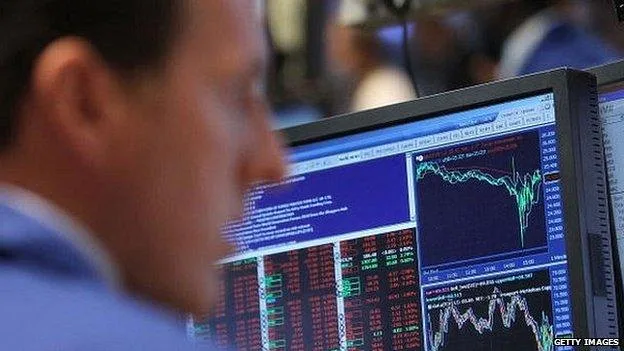
The May 6, 2010 'Flash Crash' saw the Dow Jones Industrial Average plunge nearly 1,000 points in minutes, partly attributed to high-frequency trading algorithms. This event serves as a stark reminder of how quickly complex automated systems can destabilize markets, a concern amplified by today's opaque AI quant models. (Source: bbc.com)
The path ahead: redefining “alpha”
AI quant technologies are powerful tools. They offer amazing analytical power. But they aren’t perfect predictors of financial markets. Their real value is helping humans make decisions. It does not replace them entirely. Future AI quant success needs better data rules and more explainable AI models. It requires a deeper understanding of market microstructure. Firms must avoid the temptation to tailor models too specifically to historical data.
The goal shouldn’t be to build an AI that perfectly predicts the future. Instead, we should build smart systems. These systems help humans understand odds and manage risk better. This means focusing on AI that can explain its reasoning, even if imperfectly. It means building models tough enough for new market conditions. The “alpha” of tomorrow won’t come from a secret algorithm. It will come from smart AI combined with human oversight and judgment.
FAQ
What is an AI quant? An AI quant is a financial professional or system that uses Artificial Intelligence, like machine learning algorithms, to analyze market data. They identify trading opportunities and manage investment portfolios.
How do AI quants differ from traditional quants? Traditional quants often rely on predefined mathematical models and statistical analysis based on economic theory. AI quants use algorithms that can learn from data, adapt, and find complex, non-linear patterns without explicit programming for each rule.
What are the main risks of using AI quant technologies? Key risks include overfitting, where models perform well on past data but fail in new market conditions. The “black box” problem makes it hard to understand AI decisions. There’s also the potential for AI to amplify systemic market risks during crises.
Can AI quants predict market crashes? AI quants can identify patterns that precede market movements. But they struggle with truly new events. Their learning comes from history. They often perform poorly during “black swan” events not represented in their training.

Supercomputers and high-performance computing clusters are the physical backbone of AI quant technologies, processing vast datasets at incredible speeds to power complex machine learning algorithms for financial analysis and trading strategies. These powerful machines enable quants to identify subtle market patterns and manage risk with unprecedented analytical depth. (Source: ailleron.com)
You might also like:
👉 Predicting Stock Market Trends: ML & Sentiment Analysis Guide
👉 The Future of DeFi Protocols: Navigating Web3’s Financial Revolution
👉 Sustainable Futures: Investment, Cybersecurity & Future of Work